

Note: The name “Samantha” is a pseudonym used to protect the privacy of my client.
Not all emotional triggers are created equal. Some signal surface-level stress, while others expose something deeper—an outdated belief, a survival mechanism, or a long-held identity that no longer fits.
In this article, we explore the transformation of a woman named Samantha, who came into a coaching session after being emotionally triggered by something seemingly small. What unfolded was a clear example of how emotional patterns, when examined properly, can lead to deeper self-awareness, personal healing, and identity restructuring.

The Initial Trigger
Samantha entered the session feeling unsettled because her child had lied to her about cutting their own hair—a fairly normal parenting scenario. But her emotional response was anything but ordinary. She felt anger, confusion, and a wave of emotional overwhelm that didn’t match the moment.
That’s often a signal: when a present-day event triggers a disproportionate emotional response, it’s not about the moment itself. It’s about what the moment represents.
The session did not focus on parenting advice. Instead, we focused on uncovering why this specific event caused such a strong reaction—and what unresolved belief or identity structure it touched.
The Importance of a Full “Nurturing Tank”
Before addressing the trigger itself, Samantha shared a recent experience where she felt deeply cared for—an event where people showed up for her without asking for anything in return. That event, while positive, turned out to be a key insight.
At the time, it felt like a pleasant surprise. But upon reflection, it revealed something deeper: the impact of being resourced, emotionally and energetically.
She realized that when her inner system is well-nourished, she feels more centered, less reactive, and more capable of handling daily challenges. But when she’s depleted—or giving from an empty place—her ability to stay grounded in emotional intensity weakens.
Key Insight: Many people expect themselves to stay composed even when emotionally or energetically depleted. Often, this stems from early conditioning where expressing needs—or shining too brightly—led to discomfort or disconnection.
Over time, dimming their light becomes a survival strategy. For Samantha, receiving support without earning it was a new feeling for her. That shift created enough safety for deeper emotional layers to surface, revealing that over-functioning was never her truth—just a habit she no longer needed.
The Deeper Issue: Safety, Trust, and Childhood Beliefs
As she reflected on why her child’s lie felt so personally painful, a memory surfaced. When she was around eight or nine years old, Samantha found out—through someone at her church—that the man she believed was her father wasn’t biologically related to her. Her parents had never told her.
The moment shaped her in ways she hadn’t fully realized. In addition to feeling betrayed, she internalized several unconscious beliefs:
- I can’t trust people to tell me the truth.
- If people lie, I’m not safe.
- I have to protect myself because no one else will.
These kinds of beliefs often sit beneath the surface for years. They inform how someone handles conflict, parenting, relationships, and leadership without consciously realizing the origin.
Key Insight: When early emotional injuries aren’t processed, similar dynamics in adulthood can re-activate the same emotional response—even when the context is completely different.
Samantha wasn’t just responding to her child’s dishonesty. Her system was responding to an unhealed experience where her entire understanding of truth and identity had once collapsed.
Parenting from an Under-Supported Inner System
As the session unfolded, Samantha began reflecting on her own parenting patterns. She had been trying to guide her child through reflective conversations, but often felt like she was failing to say the right thing. She felt pressure to be emotionally available and wise, even when she was running on empty.
What hadn’t occurred to her was this: The “mother” part of her also needed nurturing.
We often hear about the importance of inner child work—but what’s less commonly discussed is how we must also support the adult roles we inhabit. In Samantha’s case, the version of her that shows up as a parent was trying to lead without having the internal backing or emotional resourcing to do so sustainably.
Key Insight: Your capacity to lead or parent others is directly tied to how well-supported the inner version of you holding that role feels. When the nurturer is not being nurtured, burnout and resentment often follow.

Patterns of Hiding and Secrecy
Later in the session, Samantha admitted she had resumed a habit she wasn’t proud of—smoking. She was keeping it hidden from her family, particularly her older children, and felt torn between wanting autonomy and fearing their disapproval.
This opened up a conversation about secrecy—not just with the habit, but as a long-standing pattern.
In her early adulthood, Samantha made bold financial and lifestyle choices that were often met with judgment from her family. Over time, she learned to keep things to herself—not because she was ashamed, but because she didn’t want to deal with the emotional cost of being questioned.
Key Insight: Secrecy often forms as a protective mechanism—not to hide shame, but to protect peace. Over time, though, it can become a habit that limits intimacy and blocks support.
Samantha had created a sense of control by keeping parts of her life private. But it also reinforced a belief that authenticity is unsafe when judgment is present.
Identity Suppression: When Joy Feels Threatening
Toward the end of the session, a deeper realization surfaced. As a child, Samantha was naturally optimistic, joyful, and inclusive. But those traits were not always well-received by the adults around her. Her mother, in particular, often reacted negatively to Samantha’s happiness—especially when she herself was unhappy.
Samantha learned, without ever being told directly, that:
- Her joy could hurt others.
- Her light made people uncomfortable.
- To be accepted, she needed to tone herself down.
These early messages shaped a belief system that had followed her into adulthood. Even now, decades later, there was a lingering tension around allowing herself to be fully seen in her brilliance.
Key Insight: Many people unconsciously dim their joy, intelligence, or leadership to avoid triggering discomfort in others. This adaptation often starts in childhood and becomes a silent filter through which they shape their entire identity.
Samantha was beginning to realize that this pattern was not her truth—it was a strategy she no longer needed.
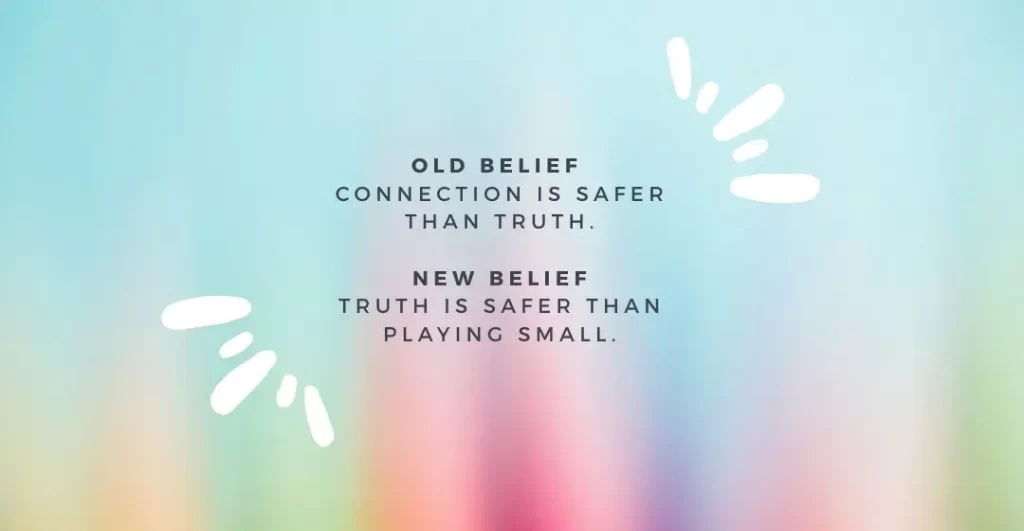
From Insight to Integration
By the end of the session, Samantha had something very powerful: a clearer view of her internal system, an understanding of how old beliefs were still influencing her, and a greater awareness of the support she truly needed.
Each of the triggers that surfaced during the session—whether it was parenting pressure, secrecy, emotional depletion, or joy suppression—showed up at just the right time and in just the right way to paint a complete picture. None of them existed in isolation; together, they revealed a full-spectrum view of how her identity had been shaped around safety, performance, and self-protection.
In that clarity, Samantha became equipped with a softness to how she leads as a mother—releasing the pressure to perform and making space for presence, empathy, and connection instead of control. She no longer needed to hold it all together to feel like a good parent; she could lead from within, supported by the clarity of who she really is.
She left the session with these internal shifts:
- The historical wound was identified and acknowledged.
- The parts of her that were carrying too much now had permission to rest or be repositioned.
- The initial emotional trigger now made sense.
This was a journey of recognition, and from that recognition, change can now begin to happen more naturally, and without force.
Identity Healing Isn’t Always Obvious
Samantha came into the session thinking she was there to talk about parenting. What she uncovered was the root system of her identity—the beliefs, wounds, and roles that had quietly shaped how she responded to the world for decades.
As the session progressed, it became clear how each of the themes that emerged—her depleted nurturing system, childhood trust injuries, hidden habits, and fear of being fully seen—were not isolated.
They were all interconnected responses to the same deeper issue: a long-standing belief that she had to manage herself in order to stay safe and accepted. The parenting trigger was just the entry point. It revealed the full network of adaptive strategies that had formed in response to early disconnection and shaped how she navigated relationships, self-expression, and leadership.
In the end, the clarity she walked away with wasn’t just about her child’s behavior—it was about her capacity to reorient how she shows up for herself, her role as a parent, and her entire way of being.
From Pattern to Possibility
This is often the case in transformational coaching. The real breakthroughs rarely happen in loud, dramatic moments. They often happen in quiet recognition. In the clarity that emerges when someone finally sees the origin of a pattern—and realizes they have the choice to change it.
If you’re noticing emotional triggers that feel bigger than the moment, it may be time to look beneath the surface. Often, these reactions are tied to early identity structures, unprocessed memories, and beliefs that were formed in environments where safety was inconsistent.
Healing is about understanding what your system has been trying to protect—and updating it with the truth of who you are now.
Are you interested in exploring this kind of transformation in your own life? I offer private coaching designed to help individuals reorganize the patterns that are no longer serving them—without needing to relive their past or figure it all out alone. Book a Discovery Call if you’re ready to begin.