

In a world of accelerating complexity, linear problem-solving just doesn’t cut it anymore. Today’s challenges aren’t problems to be fixed—they’re systems to be understood, tensions to be held, and opportunities to be designed. DesignShop offers a way forward in solving complex business challenges. It equips leaders with the tools, space, and collective intelligence required to navigate the complexity with clarity, creativity, and coherence.
Complexity Is Not the Same as Complication
Many organizations confuse complex problems with complicated ones. A complicated problem has many parts, but it’s ultimately solvable with expertise, time, and effort. Think of fixing a broken supply chain or implementing a new piece of software. These problems may be difficult, but they are manageable within the boundaries of known variables.
Complex challenges, however, are a different beast. They involve constantly changing variables, human dynamics, and ripple effects that can’t be predicted in advance. There’s no single best solution, and attempts to apply linear logic often create more chaos. Strategy stalls. Teams spin. And leaders, even with the best intentions, find themselves stuck in cycles of reactive behavior.
Consider the challenge of reshaping a company’s culture after a merger. Or navigating product innovation across global markets with differing regulations and consumer preferences. Or even responding to massive societal shifts that impact employee engagement, trust, and purpose. These aren’t problems with simple solutions—they are living ecosystems that require entirely new ways of thinking.
That’s where DesignShop enters. Not as a consultant’s toolkit or a tactical checklist, but as an experiential methodology designed to reorient how leaders and teams interact with complexity. It brings a mindset of design, a structure of synthesis, and an ecosystem where breakthroughs aren’t just possible—they’re inevitable when the right environment is created.
The DesignShop Approach
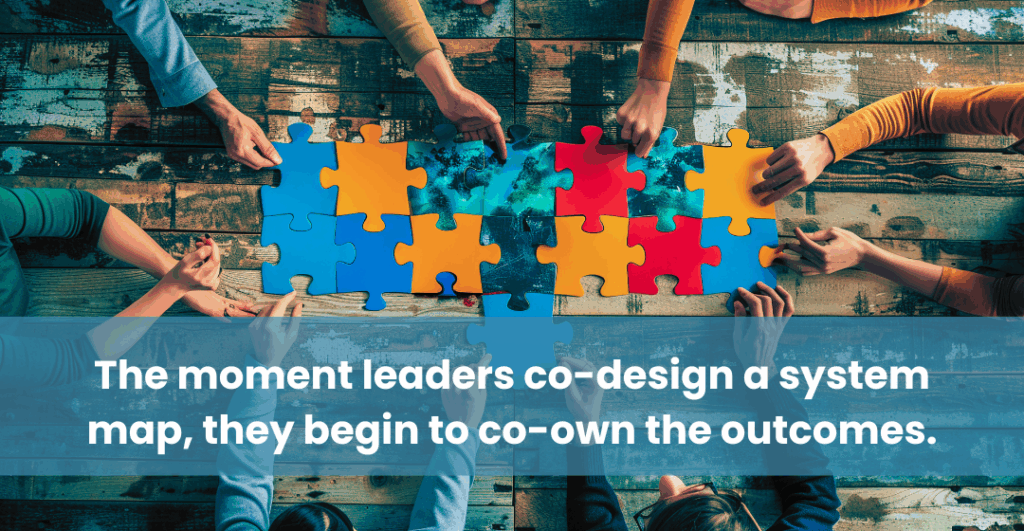
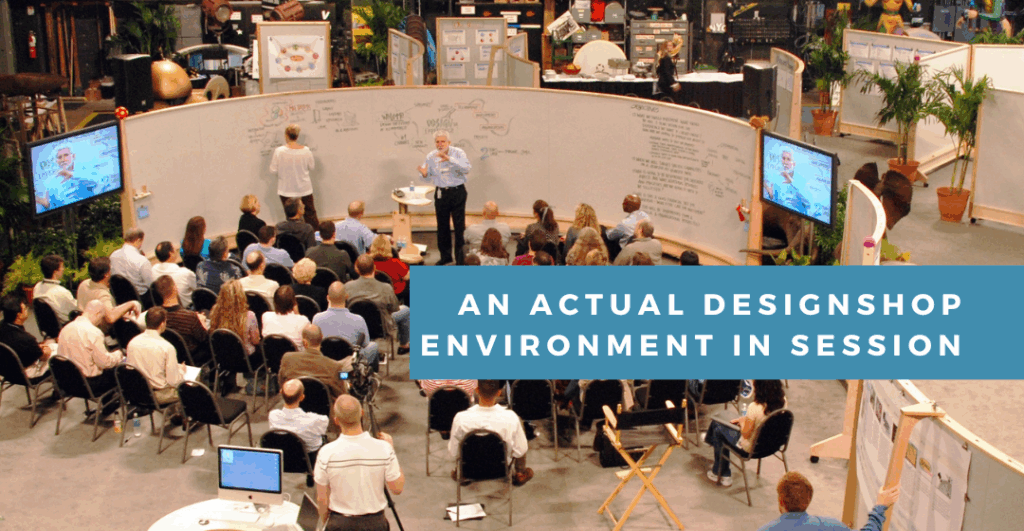
At its core, DesignShop is a designed experience. It is immersive by design, moving teams out of traditional meeting culture and into a collaborative environment where time, space, and thought are structured to support clarity and co-creation. But more than the structure, it’s the intention behind the process that sets it apart.
DesignShop does not begin by trying to “solve” the problem right away. It starts by helping the group reframe the challenge itself. What seems like a surface-level issue—declining sales, low engagement, poor cross-functional collaboration—often reveals itself as a symptom of a deeper systemic misalignment. Through visual mapping, structured dialogue, and exploration of perspectives that usually go unheard, the team is able to see not only the challenge—but their own relationship to it.
Participants in a DesignShop often find themselves saying things like, “I didn’t realize how much I was operating on assumptions,” or “We’ve never had this conversation before.” This is where transformation begins. Not in solving harder, but in thinking differently. The process pulls people out of analysis paralysis and into a generative space, where complexity doesn’t need to be controlled—it can be held and explored.
This shift in how challenges are engaged often leads to a secondary shift in leadership posture. Leaders stop trying to dominate the problem with authority. Instead, they begin to host the system with presence. They listen more. They ask better questions. And they become more open to solutions emerging from the collective, not just the top of the org chart.
What Makes It Work
DesignShop creates the conditions for new thinking by deliberately disrupting the patterns that keep organizations stuck. It removes people from familiar settings, routines, and hierarchies and places them into a high-trust, high-creativity container.
There’s no rigid agenda. Instead, there is a carefully choreographed arc of engagement that mirrors the complexity of the challenge. The session might begin with exploration—unpacking current realities, surfacing contradictions, and mapping the external environment. As the group begins to metabolize what they’re seeing, the dialogue becomes more integrative—connecting insights across disciplines, reconciling tensions, and creating a shared language for what’s emerging. Then, as energy converges, prototypes, priorities, and strategic direction begin to form organically from the shared experience.
This is not “brainstorming.” It’s not about idea volume. It’s about sense-making, co-creation, and the deep alignment that comes from being seen, heard, and invited to contribute meaningfully to the future.
Importantly, this work also happens at the level of embodiment. DesignShop sessions don’t just engage the mind—they create a whole-system experience. Participants move around, engage visually, and experience different modalities of thinking. They’re not just talking—they’re drawing, modeling, and building. This creates a kind of muscle memory for alignment. People leave not just knowing what they decided—but remembering how it felt to decide it together.
Real Results, Real Change
DesignShop has been used by Fortune 100 companies, government agencies, nonprofits, and innovation labs to tackle everything from global brand reinventions to post-crisis turnarounds. What makes the method effective is not just its tools—but the transformation it catalyzes in how people show up.
Take the example of a healthcare organization navigating post-pandemic restructuring. Leadership was overwhelmed, staff burnout was high, and the previous strategic plan no longer fit the landscape. The instinct was to retreat into tactical quick fixes. Instead, we hosted a three-day DesignShop that brought together frontline staff, department heads, and executive leadership.
What emerged was not just a new operating model—it was a shared sense of purpose. People saw one another across roles for the first time. Voices that had been silenced by urgency were finally heard. And the solutions that emerged weren’t top-down—they were co-created, deeply informed by lived experience, and ready to be implemented because those responsible had already begun to own them.
Another example comes from a tech firm on the brink of product collapse due to internal misalignment. Engineers, designers, and sales leaders couldn’t agree on where to focus. Through DesignShop, the team discovered that the real issue wasn’t the roadmap—it was the story. No one had a shared narrative of what the product was meant to do in the world. Once that story was clarified together, decisions became obvious. Resources flowed. Tensions dissolved. What had been a stalled initiative became a movement.
The Inner Work of Complexity
One of the most underappreciated benefits of DesignShop is how it supports inner transformation. Leaders walk in expecting to solve external problems. They walk out having shifted internally.
The complexity we face in business is mirrored by complexity in ourselves—our competing roles, our identities, our need for control, and our fear of uncertainty. A true DesignShop doesn’t just tackle strategy. It invites participants to confront how they respond to pressure, ambiguity, and power.
This inner work matters. Because no organization can outgrow the mindset of its leadership. If the people at the center of strategic decision-making aren’t expanding their awareness, neither will the strategy.
That’s why DesignShop is designed not only to deliver insights, but to expand capacity. It builds the muscle for sitting in discomfort, making meaning together, and acting with clarity even when certainty is unavailable.
Leading Through Design
We are entering an era where challenges will only grow more complex. AI, climate change, geopolitical instability, and cultural transformation are reshaping every industry. There will be no “getting back to normal.” There will only be the organizations who learn to think, adapt, and design in real time—and those who don’t.
DesignShop offers not a solution, but a way of engaging with complexity that honors the intelligence of the system. It brings people together in ways that change what they see, what they believe, and what they’re capable of doing.
In a world that often asks leaders to choose between speed and depth, between performance and presence, between strategy and soul—DesignShop says: you don’t have to choose. You can hold the whole system. You can work with what’s real. And you can design your way forward.
Let’s Talk
If you’re facing complexity, misalignment, or a moment of reinvention, a DesignShop may be exactly what your organization needs. It’s not another workshop and it’s not another offsite. It’s a custom-designed container that pulls you and your team out of the swirl of business-as-usual so you can see the system clearly, name what matters most, and make decisions that finally hold.
Custom packages start at $50K and scale based on scope and outcomes. That investment is not for “just a few days together”—it’s for a level of clarity that often saves months, even years, of wasted motion. It’s for alignment that accelerates everything else you do.
When you step into this work, you get more than a process. You get a partner who designs the space where your smartest people think differently, connect dots they couldn’t see before, and move forward together instead of in pieces.
Reach out to explore whether this methodology is right for you. We’ll talk about where your organization is now, where it needs to be, and what it will take to get there. If there’s a fit, we’ll design a process tailored to your goals—so you leave with a structure, a plan, and a way forward that no longer rests on your shoulders alone.