
There comes a point in every journey of deep personal healing where your internal world begins to change faster than your external one. What once resonated no longer fits. What once felt like comfort now feels like compromise, and you begin to hear the unmistakable voice of your True Self—clear, direct, and stable—and with it comes a challenging invitation: to stand your ground in your knowing.
Throughout your healing journey, your nervous system will use strong emotional cues—like anger, sadness, rage, and frustration—as signals that something within needs your attention. These are physiological alerts pointing to what remains unresolved, what memories or patterns are still stored in your system, and where your current reality is out of sync with your core self. These signals are how the body says, “Something here needs to be integrated, aligned, or released”.
(Go here to learn more about nervous system cues: When Healing Feels Hard)
Because you can trust that when internal changes happen, your relationships—every single one of them—will have no choice but to respond.
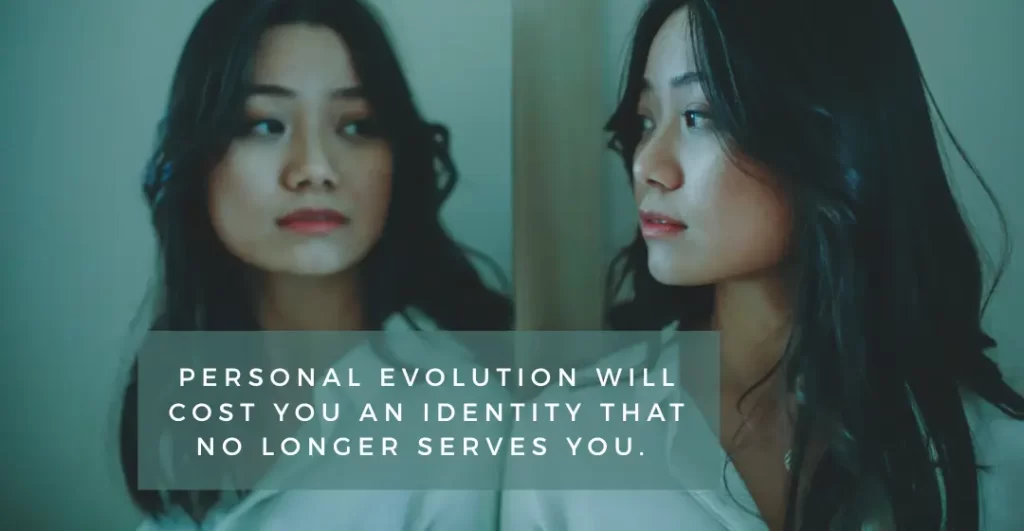
This part of the healing journey is what I like to call the unintended unfoldment of stepping into who you really are. The process of becoming your true self rarely goes the way your mind thinks it should. You shed identities you didn’t realize you were still wearing. You say no to roles that once earned you love and a sense of belonging. And in doing so, you disrupt familiar patterns, which forces change in every relational dynamic around you.
This article is for those awakening to a deeper inner clarity—where truth feels undeniable, but also feeling raw and uncertain as relationships shift in unexpected ways.
Let’s reclaim your power by standing firm in your knowing.
Because bae-bee, this is where growth meets grit in relationships.
The Nature of the Shift
When you begin to heal and integrate the fragmented parts of yourself, something miraculous happens: your energy stops leaking. This is what it means to take your power back. You no longer feel the compulsion to perform, persuade, earn, or people-please your way into connection. Instead, you begin to show up rooted, anchored, and sourced from within — no longer searching for safety in others, but becoming the source of it for yourself.
But let’s be clear: this doesn’t always look peaceful. In fact, it rarely feels that way in the beginning.
The shift from performance to presence can be jarring. You may find yourself:
- Frustrated by conversations that once felt fine but now feel hollow
- Pulled to retreat from social dynamics that used to feel energizing
- Misunderstood by people who still mirror your past self
- Exhausted by trying to “translate” your new self to others who can’t—or won’t—understand
- Grieving relationships that can’t or won’t stretch to meet the truth of who you are now
- Feeling emotionally fatigued—or even betrayed—when others don’t honor the boundaries you’ve worked so hard to set and uphold
These experiences are not a sign that you’re doing something wrong. They’re a sign that you’re doing something right, and you’re shedding the illusion that connection must come at the cost of yourself.
What’s Actually Happening?
Through the healing journey you are recalibrating your entire internal system. Your nervous system is learning to sustain higher levels of coherence, congruence, and grounded presence. You are building new energetic infrastructure for your True Self to live through you.
Old identities—especially those shaped to earn love, avoid pain, or create safety—are dissolving. Literally. Neural pathways wired for survival are being deprived of energy and begin to fade. As with any ego (or synaptic) death, this process can feel disorienting, confusing, and even terrifying. Your body may move through waves of emotion—fatigue, unexpected grief, flashes of euphoria. You might crave silence and solitude more than ever, or feel deeply porous around those still operating from outdated patterns.
This is the body’s way of saying: “We’re updating the signal between the emotional system and the nervous systems. Please don’t disrupt the transmission.”
As you expand your being, your field must be protected, and in this process discernment becomes a super power.
Standing your ground in your knowing means that your internal reality becomes the primary focal point for you—not other people’s reactions, not external validation, and not even your own conditioned doubt.
That feeling? That’s alignment finding its way into your nervous system.

The Betrayal of Boundaries: Powerlessness in the Face of Resistance
A pivotal moment in your healing journey may come when you realize that your boundaries are not always met with the respect you’ve worked so hard to cultivate. You may set a clear boundary, only to have it ignored or manipulated by someone you trust. This is an incredibly disorienting experience, especially when the person doesn’t just violate the boundary—they hide their actions to avoid accountability.
In moments like these, it’s normal to feel betrayed. You may feel powerless, like your growth and the clarity you’ve worked so hard to embody mean nothing in the face of someone else’s resistance. It’s easy to question your own worth or wonder if you’ve done something wrong. But here’s the truth: when you stand firm in your knowing, even when others resist, you are honoring the deepest part of yourself.
These moments are simply a reflection of the energetic shift taking place within you. As your internal world recalibrates, your external world will shift to catch up. This recalibration may cause discomfort, especially in relationships that have been built on old dynamics. But your true self cannot be dimmed by someone else’s inability to meet you where you are.
The discomfort you feel is a sign that your boundary is the right one. It’s a test of your resilience, your ability to hold your ground, and your willingness to honor your truth, even when it’s difficult. In these moments, the only choice is to stay true to yourself and let others recalibrate in their own time.
Protecting Your Frequency: The High Cost of Leaking Energy
In the process of becoming who you truly are, there’s a subtle—but costly—trap: trying to prove your new self to people who are still attached to your old self. It’s natural to want to be seen in your clarity. But not everyone can meet you there. Not immediately. Not always.
When you over-explain, overcompensate, or try to earn approval for your evolution, you start leaking energy. More critically, you send a signal to your nervous system that it’s not safe to hold this new identity unless it’s externally validated.
That’s a dangerous game to play with your own power.
And here’s the truth—your growth isn’t up for negotiation. It’s not your job to make others comfortable with your expansion. It is your responsibility to protect the frequency you’ve worked so hard to reclaim.
This is where many unconsciously retreat. The pull to keep the peace, to avoid discomfort, or to stay in relationships that once felt like home can be strong. But peace that requires self-abandonment is not peace—it’s performance.
As your system recalibrates to this higher integrity, you’ll notice some relationships begin to feel misaligned. Not because there’s blame or fault—but because the resonance has changed. You’re no longer available to play the roles that once made others feel safe: the fixer, the chameleon, the pleaser, the peacekeeper, the one who overextends to stay connected.
Those around you might resist that change. They may try, consciously or not, to pull you back into dynamics that feel familiar to them—even if they’re harmful to you.
Pay attention because this is a pivotal moment. You can collapse into guilt and turn back, or you can hold your ground and move forward. Guilt isn’t guidance—it’s a residue from a self who believed love had to be earned through self-sacrifice.
But that’s not the truth any longer to someone who’s actively healing. The more you honor your clarity, the more your system learns to trust itself. And from that place, alignment—not approval—becomes the foundation of your connections.
Standing in Your Knowing Is a Devotional Act
To stand your ground in your knowing is to anchor into your inner alignment with quiet authority. It’s not about broadcasting your truth—shouting often stems from unhealed wounds. True power is when your truth is so fully embodied, it no longer needs defense.
This might look like:
- Saying less, and letting the tone of your presence speak
- Creating space from dynamics that drain you, without feeling guilt
- Refusing to explain your boundaries for the fifth time, and simply holding them energetically in your body
- Letting people misunderstand you, without ever feeling the need to correct them
- Grieving what’s ending, and honoring and celebrating what’s emerging
This kind of clarity is a form of spiritual maturity, and it requires you to get comfortable being the disruptor from a place of honoring, respecting and loving yourself for the progress you’ve made.
The Courage to Hold Space (Even When Others Don’t)
When you’re doing the work your entire frequency shifts, and the quantum field responds. You speak with more coherence and authentic confidence. You breathe with a calming yet powerful presence. You walk into a room and the atmosphere adjusts to you.
But while your inner world is changing, others may only know how to relate to the previous version of you.
Here’s the courageous part: You must hold space for them to process the new you, without collapsing into their expectations.
They may question your shift, or resist your boundaries. They may accuse you of being “too much” or “too distant.” They may say, “You’ve changed,” and expect you to take that as an insult to change back into the version they are most comfortable with.
Don’t do it. Take this relationship exchange as evidence of your growth.
Growth always comes with a need for a recalibration period. But your job is not to make others catch up. Your job is to hold your resonance long enough for your external world to adjust and mirror your new standard/baseline of your alignment.
This is not demonstrating a coldness to people, it’s demonstrating clarity of who you are.
Practical Ways to Hold Your Frequency Through the Shift
- Create Ritual Space for Integration
Journal, meditate, walk in silence, or connect with nature daily. Your body is the container for your frequency. Keep it clear and resourced. - Set Clear Boundaries Without Justification
“No” is a complete sentence. You don’t need a five-paragraph explanation to honor your nervous system. - Speak Less, Observe More
Not everyone is meant to understand you. Save your breath for those who can meet you where you are. - Anchor Into Like-Resonance Relationships
Seek out people, spaces, or mentors that reflect your new frequency. Alignment accelerates in the presence of resonance. - Allow Emotions to Process Without Story
Let yourself feel all the feelings, but don’t make it mean you’re wrong for choosing you.
Becoming Who You Are Is the Most Radical Act
To stand your ground in your knowing is to live in integrity with your core-self—even when it costs you roles, relationships, opportunities, or recognition.
You are not here to be understood by everyone. You are here to be true to yourself.
Allow everything else within you to recalibrate at its own pace, so your entire system—mind, body, and emotions are working in harmony to support your growth, healing, and evolution.
When you stop pouring energy into fitting into spaces you’ve outgrown, you reclaim your life as your own. From that place of alignment, everything around you begins to shift—naturally and inevitably—to support who you really are.
An Invitation
If this message stirred something in you — if you’re done betraying yourself to avoid being betrayed — then now is the time to anchor your power at a whole new level.
I guide people through the deep work of healing, integration, and nervous system repatterning so they can show up sourced, not scrambling.
Ready to reclaim your inner authority and lead from wholeness? Book a Discovery Call.
Your next chapter starts with you becoming unshakable.